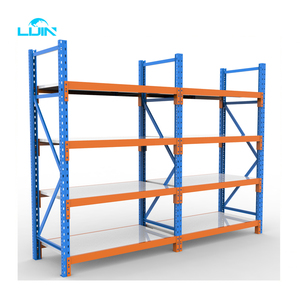
Boltless Adjustable Heavy Duty Pallet Racking System
Rivet-lock boltless assembly with adjustable beams, 500–3,000 kg per level, powder-coated or galvanised finish, and flat-pack export loading to cut freight cost per pallet position.
View productEvery system below is manufactured in our own facility, not assembled from third-party parts. Beam levels, upright thickness, coating, colour, branding plates and packaging are all configurable — whether you send us a drawing or select one of our engineered designs.
Rivet-lock boltless assembly with adjustable beams, 500–3,000 kg per level, powder-coated or galvanised finish, and flat-pack export loading to cut freight cost per pallet position.
View product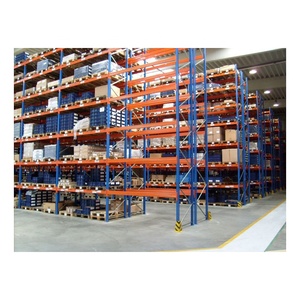
Selective pallet racking engineered around your pallet footprint, aisle width and forklift type, with RAL colour matching, OEM branding plates and full load signage supplied.
View product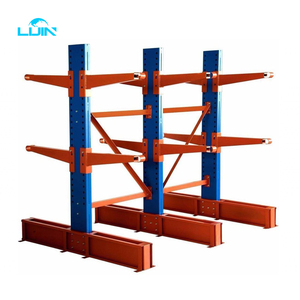
Open-front storage for pipes, profiles, timber and steel bars up to 12 m. Single or double sided, indoor or outdoor, hot-dip galvanised for humid and coastal sites.
View product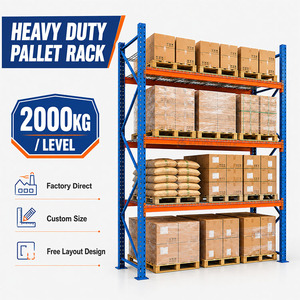
Box-beam and step-beam construction with safety pins, end guards and column protectors, calculated to EN 15512 for high-load industrial warehouses.
View product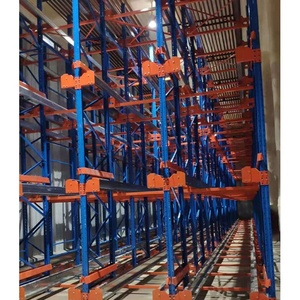
High-density shuttle racking where one forklift feeds deep lanes by radio control — fewer aisles, faster put-away and significantly more pallets per cubic metre.
View product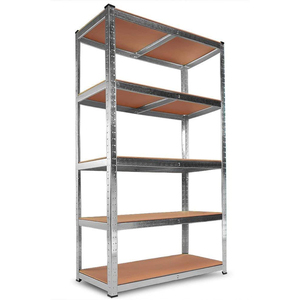
Hand-loaded shelving for cartons, spare parts and e-commerce SKUs. Five levels, mesh or steel decks, optional dividers and multi-tier walkway configurations.
View product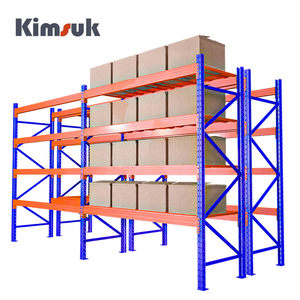
A complete pallet storage solution shipped as one kit: uprights, beams, decking, column guards, anchor sets, load labels and an installation drawing pack.
View product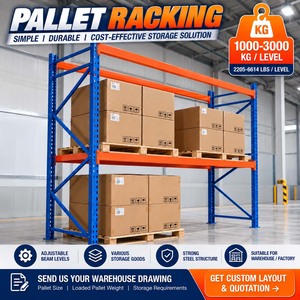
Wholesale-grade racking rated to 3,000 kg per level, factory-tested before shipment and delivered with packing lists, mill certificates and load capacity tables.
View productNot seeing your configuration? Send a drawing, a pallet specification or a warehouse layout — we will return a design, a structural calculation scope and an FOB price within two working days.
Get CatalogIndustrial storage shelving is bought like a commodity and lived with like a structure. Two quotations can look identical on paper — the same number of uprights, beams and levels — while differing in steel grade, upright wall thickness, weld penetration, powder-coat microns, floor-fixing specification and, most importantly, the documentation that proves all of it. Most buyers never see that difference until an annual rack inspection, an insurance audit or a seismic event forces the question.
That is the core argument for buying from a factory that offers genuine OEM and ODM capability rather than from a trading desk. When you buy direct, you approve the drawings, you receive mill certificates, you specify the coating and the packaging, and you keep the tooling records that make next year's expansion compatible with what you already own. The storage system is a structural product, not a shelving kit — and the factory behind it should be able to prove the difference in writing.
Real Nice Racks operates both models in parallel. OEM customers submit drawings or samples and receive build-to-print manufacturing with private labelling. ODM customers select from our engineered platforms — selective, double-deep, drive-in, push-back, shuttle, cantilever or multi-tier — and we adapt structure, finish and packaging to their market. Either way, the same engineering team signs off the load calculation before a single upright is cut.
Both models ship from the same production line. The difference is who owns the design intent — and how much engineering risk sits on your side of the contract.
You supply the drawing, the load table and the brand specification. We convert it into production-ready shop drawings, verify the section properties against EN 15512, manufacture, inspect and ship with your logo, your manual and your packing marks. Ideal for distributors, racking brands and system integrators who already own the market position.
You describe the warehouse: clear height, pallet size, load per pallet, handling equipment, seismic zone and temperature. Our engineers return a layout, a capacity comparison and a structural calculation scope; you approve it and apply your own brand. Faster to market, lower design cost, and backed by a factory that has already solved the same problem for other regions.
Most mature buyers end up running a hybrid: ODM for standard bays they resell repeatedly, OEM for the specials — cantilever arms for a steel service centre, pull-out drawers for a mining spare-parts store, or a bespoke mezzanine that must fit an existing column grid. Because both models run on the same platform and the same tooling, spares and future extensions stay interchangeable.
Procurement teams, insurers and regulators increasingly ask a simple question: prove it. A pallet rack is a structure that carries tonnes above people, so the deliverable is not just steel — it is a calculation, a label and an inspection record.
Static steel racking is designed in line with EN 15512, with floor tolerances per EN 15620 and use-and-inspection guidance per EN 15635. Seismic design follows FEM 10.2.08 / EN 16681 and is coordinated, where required, with locally licensed structural engineers against national codes. You receive the numbers, not just the product.
Every shipment can include the structural calculation report, load capacity labels for each beam level, anchor specification and pull-out requirements, mill certificates for the steel, coating thickness reports, an installation manual with torque values, and a pre-shipment inspection report with photographs. Third-party witnessing (SGS, TÜV, BV) can be arranged on request.

Supervised installation with documented handover, load signage and an inspection baseline for year one.
Claims are cheap. Everything below can be checked during a factory audit, a video walkthrough or a sample order.
Layout design, 3D modelling, section verification and load calculations are done by our own engineers — not outsourced after the order is placed. Design changes therefore reach the production line the same day.
Roll-forming, punching, welding, pre-treatment and powder coating are controlled under one roof, so tolerances, colour consistency and delivery dates are ours to guarantee rather than to negotiate.
Incoming steel verification, dimensional checks, weld inspection, coating thickness measurement and a full pre-shipment inspection with photographic evidence — documented against the approved drawing, every batch.
Nested uprights, bundled beams, edge protection and moisture barriers sized to maximise container fill. FOB, CFR or CIF to Santos, Callao, San Antonio, Buenos Aires, Cartagena, Guayaquil and Montevideo.
Technical and commercial communication in English, Spanish and Portuguese — so drawings, packing lists and installation manuals arrive in the language your installers and your customers actually read.
Installation supervision, periodic rack inspection, damage assessment, replacement parts and capacity upgrades for the life of the system — the part most exporters quietly leave out of the offer.
Buying behaviour has shifted faster in the last three years than in the previous fifteen. These six forces are now visible in live tenders across Latin America, the Middle East and Southeast Asia.
Buyers now model freight per pallet position, installation hours, inspection cost, downtime risk and residual value — not price per bay. A lighter, better-nested design often wins even at a higher kilogram price.
Instead of ten local fabricators, buyers appoint one or two qualified factories that can supply racking, shelving, mezzanines and spares together — with a documented second source for risk cover.
Even manual warehouses are now specified for a future shuttle, AMR or goods-to-person layer: tighter floor flatness, reserved interface points and rack heights calculated for the next five years of growth.
Requests for declarations, certificates, calculation reports and inspection regimes now appear in the RFQ itself — a supplier who cannot produce paperwork is disqualified before the commercial negotiation starts.
Land prices around São Paulo, Santiago, Lima and Bogotá have pushed buyers toward height and density: narrower aisles, mobile bases and shuttle lanes that convert vertical space into payable capacity.
Procurement teams specify the discharge port in the RFQ and compare landed cost by container fill rate, consolidating racking with other warehouse equipment to reduce freight per tonne.
Four development directions are visible on our drawing board — and they are already shaping the specifications buyers put into tenders.
Shuttle, push-back and mobile systems are merging into modular platforms so a warehouse can start manual and add automation lane by lane without replacing the steel.
Optimised section profiles push usable heights past 12 m while reducing steel per pallet position — the single most effective lever on both carbon footprint and capital cost.
Freezer-rated coatings and materials down to −30 °C, plus seismic detailing for the Pacific belt — bracing, base plates and anchors specified by zone and soil type.
Higher recycled content, chrome-free pre-treatment and longer-life powder systems are moving from marketing language into purchase specifications and warranty terms.
A predictable five-stage workflow that keeps budgets, approvals and shipping windows under control — even on multi-country rollouts.
Pallet size and weight, clear height, floor plan, forklift type, temperature and seismic zone are captured before any price is quoted.
Two or three layout options with capacity comparison, aisle analysis and a structural calculation scope for the selected concept.
Shop drawings, colour chips and packaging mock-ups are approved before production. Pre-production samples are available for OEM programs.
Roll-forming, welding, coating and assembly checks against the approved drawing, followed by a photographic pre-shipment inspection.
Export packing, container loading plan, shipping documents to your port, then installation supervision, spares and periodic inspection.
Three cost layers decide whether a racking project is cheap or expensive — and only the first one appears on the supplier's invoice.
Steel weight, coating specification, container fill rate and duty classification. A design that nests 8% tighter can save more than a 5% discount on the unit price.
Boltless connections, clear drawings and pre-labelled parts shorten installation by days. On an operating site, one avoided day of downtime can outweigh the entire steel cost difference.
Inspection findings, damage repairs, capacity upgrades and insurance conditions. Documented design and load signage reduce both the frequency and the cost of those events.
When buyers model all three layers, the specification conversation changes: the question stops being "what is the price per bay" and becomes "what is the cost per usable pallet position over ten years". That is the number a factory partner can actually optimise — through density, height, connection design and container planning, not through thinner steel.
ODM programs typically start from one 20ft container, which is roughly 60–120 pallet positions depending on bay size and packing efficiency. OEM programs built to your own drawings usually start from one 40ft high-cube container because of tooling, labelling and packaging set-up. Mixed containers combining pallet racking, cantilever and shelving are common and often reduce freight cost per tonne.
Standard selective racking is normally 15–25 working days after drawing approval; cantilever, shuttle and multi-tier systems run 25–40 working days. Add ocean transit of roughly 25–40 days to Santos or Buenos Aires, 20–30 days to Callao or San Antonio, and 30–40 days to Cartagena or Guayaquil. Seismic projects add one to two weeks for calculation review by a locally licensed engineer.
Yes. Send DWG, PDF or STEP files with the load table and we will convert them into production drawings, verify section properties and flag any structural or tolerance issue before quoting. Private labelling covers upright stamping, brand plates, carton printing, manuals in your language and your own part-numbering system so future spares remain traceable.
Design follows EN 15512, with floor tolerances per EN 15620 and inspection guidance per EN 15635. Seismic projects reference FEM 10.2.08 / EN 16681 and are coordinated with local codes such as NBR 15524 in Brazil, NCh 433 and NCh 2369 in Chile, E.030 in Peru, NSR-10 in Colombia and NEC-SE-DS in Ecuador. The document pack includes the structural calculation report, load capacity labels, anchor specification, mill certificates, coating thickness reports and a pre-shipment inspection report.
Both are routine. Cold-store systems are specified for chilled and frozen environments down to approximately −30 °C, using materials and coatings that remain stable through freeze-thaw cycling. Seismic systems use heavier base plates, engineered bracing and site-specific anchor design for the seismic zone and soil class — critical for warehouses in Chile, Peru, Ecuador and Colombia.
Goods are export-packed with edge protection and moisture barriers, loaded to a container plan that maximises fill, and shipped FOB, CFR or CIF to your nominated port. We provide packing lists, load plans and unloading sequence guidance. Installation can be supervised by our technicians on site, or executed by your local contractor using our drawings and torque specification, followed by an inspection baseline at handover.
Yes. Retrofit projects usually combine a re-layout with higher-density systems — drive-in, push-back, shuttle or mobile racking — plus mezzanine floors and narrow-aisle configurations. High-density racking can deliver up to 20% more storage capacity within the same building footprint, which avoids both the capital cost and the permitting delay of new construction.
The catalogue covers all eight platforms with load tables, section drawings, coating options, container loading data and the documentation supplied with each shipment. Send your warehouse location, floor plan, clear height, pallet dimensions, load per pallet and handling equipment, and our engineers will return a layout and an FOB quotation within two working days.
Get CatalogDirect technical support: [email protected] · English · Spanish · Portuguese