8 Pallet Shelving Systems Recommended for Export Buyers
This product family covers selective pallet racking, cantilever storage, multi-level racking and heavy-duty warehouse shelving. Each system can be engineered to project-specific loads, finishes, seismic conditions and delivery ports.
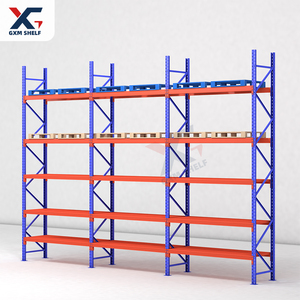
Heavy Duty Pallet Racking Warehouse Pallet System Pallet Storage Rack Heavy Duty Rack Shelf Heavy Duty Racking System
A beam-and-upright selective system for pallets from 500 kg to more than 4,000 kg. Adjustable beam levels, bolted frames and a modular layout support fast SKU changes.
View product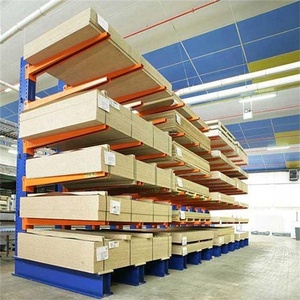
Heavy Duty Industrial Warehouse Storage Cantilever Arm Racking System
Open-front cantilever arms store pipes, timber, steel profiles and other long loads. Single- or double-sided layouts reduce handling damage and use clear height efficiently.
View product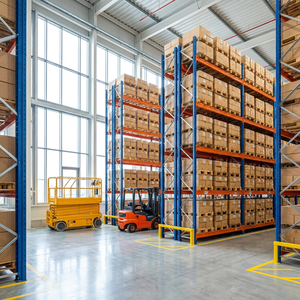
Q235B Steel Certificate Rack Size Certificate Heavy Duty Rack Multi Level Pallet Rack Warehouse Shelving
Q235B steel with mill certificates, multi-level pallet racking for medium-to-heavy warehouse shelving. Suited to buyers who need traceable material and repeatable quality.
View product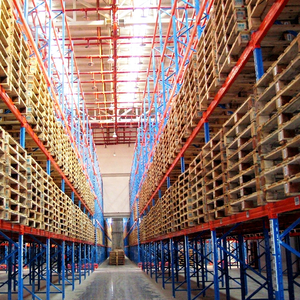
Manufacturer Heavy Duty Warehouse Shelving/storage Pallet Rack /selective Heavy Duty Racking System
A manufacturer-direct selective pallet racking system for fast-moving pallets. High selectivity, simple beam adjustment and compatibility with forklifts, reach trucks and AGV operations.
View product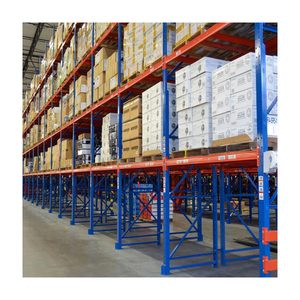
Wholesale Price Heavy Duty Storage Racks Warehouse Stacking Racks Selective Steel Pallet Rack Heavy-Duty Racking for Sale
Stacking and selective steel pallet racking with a wholesale price structure. Ideal for distributors, 3PLs and warehouse projects that need cost control without sacrificing capacity.
View product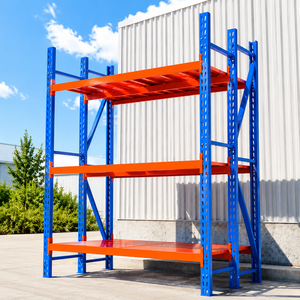
Wholesale Pallet Racking System Heavy Duty Warehouse Industrial Metal Storage Shelving
Industrial metal storage shelving and heavy-duty pallet racking for warehouses. Engineered layouts can combine selective aisles with high-density zones for better space utilisation.
View product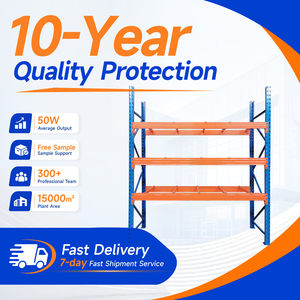
Adjustable Pallet Rack Warehouse Storage Heavy Duty Shelving Pallets Racking for Warehouse Storage
Adjustable pallet racking built around slotted uprights and beam connectors. Easy to reconfigure, inspect and extend — a practical baseline system for export markets.
View product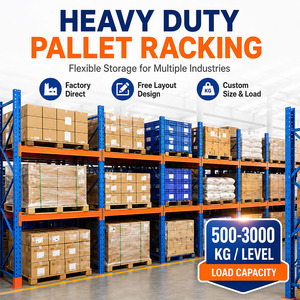
Heavy Duty Steel Warehouse Pallet Rack Storage Racking System for Industrial Warehouse Applications
A robust pallet rack and racking system for industrial warehouse applications. Designed for high load cycles, documented capacities, long service life and future expansion.
View productChina Pallet Shelving Factory & Supplier: What Serious Buyers Should Evaluate
In global procurement, “pallet shelving” is often used as an umbrella term for selective pallet racking, heavy-duty racking, warehouse storage shelving and long-span systems. A factory may manufacture uprights, beams, bracing, base plates and accessories, but a reliable supplier must do more than ship steel. It must translate pallet dimensions, load weights, throughput targets, clear height, floor tolerances and local codes into a layout that works in daily operation.
The lowest price per kilogram is rarely the lowest total cost. A racking project can fail commercially if beams are undersized, documentation is incomplete, powder coating is unsuitable for the climate, containers are poorly packed, or installation instructions do not match the delivered components. For importers and project buyers, the real question is not “Who can quote the cheapest pallet rack?” but “Which factory can provide a predictable engineering outcome, documented safety and export-ready delivery?”
A strong proposal should show load capacity per beam level, upright frame capacity, deflection limits, surface finish, packaging method, technical submittals and the assumptions behind the layout. It should also identify whether the system is selective, drive-in, push-back, shuttle, mobile or cantilever, because each format has a different balance of density, selectivity and capital cost.
For buyers sourcing from China, supplier evaluation should include raw material traceability, welding quality, dimensional consistency, coating adhesion, pre-shipment inspection and documentation. This is especially important for projects in seismic zones, cold stores and multi-country rollouts where one weak component can delay an entire warehouse programme.
Need a layout review before you request pricing? Send your pallet data and warehouse drawing to our engineering team.
Years of racking and storage engineering experience
Export markets supported with project documentation
Pallet positions and shelving bays engineered annually
Pre-shipment inspection on export orders
Why This China Pallet Shelving Factory Is Built for Export Projects
The operating model behind Real Nice Racks LLC combines China-based pallet shelving manufacturing with project engineering, multilingual communication and South America delivery experience. Instead of selling disconnected components, the team coordinates design, production, inspection and lifecycle support.
Engineering before quotation
Layouts are developed from pallet profiles, load weights, clear height, forklift types and SKU velocity. Beam selection, upright frame capacity, floor tolerance and access aisle width are reviewed before pricing is finalised.
Standards-led manufacturing
Static racking can be designed with reference to EN 15512, floor tolerances per EN 15620, use and inspection guidance per EN 15635, and seismic methodology such as FEM 10.2.08 / EN 16681 where required.
Seismic-ready and cold-chain ready
For the Pacific seismic belt, base plates, anchors, bracing and beam connectors can be specified for site conditions. For chilled and freezer warehouses, materials and finishes can be adapted for temperatures down to approximately -30 °C.
Export packing and port experience
Components are packed for container efficiency and moisture protection, with project support for ports such as Santos, Callao, San Antonio, Buenos Aires, Cartagena, Guayaquil and Montevideo.
Multilingual project communication
Technical submittals, load signage, packing lists and installation guidance can be coordinated in English, Spanish and Portuguese for procurement teams, contractors and warehouse operators.
Lifecycle support and retrofit capability
Support extends beyond delivery: rack inspection, damage repair, capacity upgrades, mezzanine integration and high-density retrofits help buyers extend the value of existing warehouse space.
Product Recommendation by Warehouse Application
There is no single best pallet shelving system. The right choice depends on SKU count, pallet velocity, load weight, picking method, building height and the cost of floor space.
Selective pallet racking
Best for high SKU counts and fast-moving pallets where direct access and quick beam adjustment matter most.
- High selectivity and simple inspection
- Works with reach trucks and forklifts
- Ideal for 3PL, retail and e-commerce
High-density drive-in and push-back
Best for slow-moving, low-SKU inventory, cold stores and seasonal buffer stock where density outweighs selectivity.
- More pallet positions per cubic metre
- Useful for freezer and chilled storage
- Can reduce aisle requirements
Cantilever racking
Best for pipes, timber, steel profiles and building materials that cannot be stored safely on standard beams.
- Open front for long-load handling
- Single- or double-sided layouts
- Indoor and outdoor configurations
Mobile and multi-level systems
Best for space-constrained warehouses where the cost of new construction is higher than a denser storage system.
- Reduces unnecessary aisle space
- Supports cold-chain energy savings
- Scalable to semi-automation
Indices are illustrative and must be confirmed by project-specific layout and structural design.
Future Procurement Trends for Pallet Shelving Buyers
Buying behaviour is shifting from component sourcing to outcome-based procurement. The most competitive suppliers will be those that can prove engineering quality, delivery reliability and lifecycle value.
Total cost of ownership over unit price
Buyers increasingly compare installation time, rework risk, inspection cost, coating durability and spare-part availability — not only the price per kilogram of steel.
Compliance evidence becomes mandatory
Procurement teams and insurers want load calculations, material certificates, capacity tables, anchor specifications and inspection records before approval.
Supply-chain resilience and dual sourcing
Importers are qualifying suppliers with export documentation, stable lead times, container planning and clear communication across languages and time zones.
Retrofit before new construction
High-density racking, mezzanines and mobile systems allow warehouses to add capacity without the cost and delay of a new building.
Cold-chain energy efficiency
In fruit, seafood, meat and dairy hubs, reducing refrigerated aisle volume is becoming a financial priority as well as an operational one.
Data readiness for automation
Warehouse layouts are being prepared for shuttle systems, AGVs and goods-to-person equipment, requiring accurate load data and modular interfaces from the start.
Product Development Trends in Pallet Shelving
Racking technology is moving toward modularity, higher strength-to-weight ratios, automation interfaces and lower environmental impact per pallet stored.
Modular platform design
Common upright, beam and accessory platforms make it easier to reconfigure, extend or integrate racking with mezzanines, shelving and automation.
Stronger, leaner steel sections
Q235B and Q355B steel, optimized roll-formed profiles and refined beam-to-upright connectors help balance load capacity, material use and cost.
Automation-ready interfaces
Racking is increasingly designed for pallet shuttles, AGV access, sensors and future goods-to-person equipment without a complete rebuild.
Sustainable finishes and lower embodied carbon
Buyers are asking for durable powder coatings, recyclable steel, optimized packaging and layouts that use less steel and energy per pallet position.
Quality, Standards and Documentation: How to Verify a China Factory
Quality is not a final inspection alone. It starts with raw material control, continues through roll forming, welding, punching and powder coating, and ends with pre-shipment checks and clear documentation. For export projects, material certificates, dimensional reports, coating checks and packing photos reduce the risk of disputes and site delays.
A serious supplier should be able to explain which standard the design follows, what load assumptions were used, how the system is anchored, and how the racking should be inspected after installation. Documentation is part of the product — not an afterthought. Load signage, capacity tables and inspection guidance should be supplied with the project.
- Mill certificates for Q235B or Q355B steel where specified
- Weld, dimension and coating inspection records
- Beam capacity and upright frame load tables
- Anchor specification and floor tolerance assumptions
- Packing list, container loading plan and installation guide

From Inquiry to Installation: A Four-Stage Project Path
A structured process keeps technical assumptions visible, budgets comparable and delivery milestones realistic.
Data collection and layout
Share floor plan, clear height, pallet size, load per pallet, forklift type, SKU profile, temperature and seismic zone. The team prepares layout options and identifies constraints.
Structural design and quotation
Beam levels, upright frames, bracing, anchors and accessories are specified. The quotation should clarify scope, standards, finish, packing and delivery terms.
Manufacturing and inspection
Production follows approved drawings. Pre-shipment inspection checks dimensions, welds, coating, quantities, load signage and packing before container loading.
Export, installation and support
Shipment is coordinated to the nearest port. Installation guidance, inspection advice and future capacity upgrades help protect the investment over time.
Common Questions from Pallet Shelving Buyers
These are the questions most frequently raised by importers, distributors, 3PL operators and project contractors comparing China pallet shelving factories.
What makes a China pallet shelving factory suitable for export projects?
A suitable factory should provide engineering support, documented load capacities, material traceability, export packing, pre-shipment inspection and clear technical communication. It should also understand international standards and local project requirements, not merely produce beams and uprights. For buyers in South America, experience with port delivery, seismic design and multilingual documentation is a practical advantage.
Can you design pallet racking to EN 15512 or local seismic codes?
Yes. Static racking can be designed with reference to EN 15512, with floor tolerances per EN 15620 and inspection guidance per EN 15635. For seismic zones, calculations can reference FEM 10.2.08 / EN 16681 and be coordinated with local requirements such as NCh 433 and NCh 2369 in Chile, E.030 in Peru, NEC-SE-DS in Ecuador and NSR-10 in Colombia. Final calculations can be reviewed with a locally licensed engineer where required.
What is the minimum order quantity for an export order?
Many projects begin with one 20-foot container, but the practical minimum depends on the system type, beam lengths, upright heights, finish and packing method. Selective pallet racking is often easier to consolidate than highly customized cantilever or mobile systems. A layout and bill of materials are needed before a reliable MOQ and freight estimate can be confirmed.
How do you control quality and packaging before shipment?
Quality control typically covers raw material certificates, profile dimensions, weld appearance, hole pitch, powder coating thickness, color consistency and accessory quantities. Pre-shipment inspection includes a packing check, load signage review and container loading plan. Steel components are protected against moisture and handling damage, and packing lists are matched to the approved drawings.
Can your racking be used in cold storage and freezer warehouses?
Yes. Racking, shelving and high-density systems can be specified for chilled and frozen environments, including temperatures down to approximately -30 °C. Material selection, coating, anchor design and condensation control should be reviewed for the operating temperature. Mobile or high-density racking can also reduce refrigerated aisle volume and lower energy consumption per pallet stored.
How is freight calculated for delivery to South America?
Freight depends on total volume, weight, container type, packing efficiency, destination port and Incoterms. Common delivery ports include Santos, Callao, San Antonio, Buenos Aires, Cartagena, Guayaquil and Montevideo. A useful quotation should separate product scope, packing, inland transport, ocean freight and local import responsibilities so buyers can compare offers accurately.
What is the typical lead time and installation support?
Lead time depends on drawing approval, material availability, coating requirements, order volume and shipping schedule. Standard selective racking projects often follow a shorter cycle than complex mobile, cantilever or cold-store systems. Installation support may include layout drawings, erection guidance, anchor specifications, load signage and remote technical assistance, with supervised installation available for larger projects.
How can buyers request a factory-direct quotation?
Send warehouse location, floor plan, clear height, pallet dimensions, load per pallet, required beam levels, forklift type, temperature range and any seismic or local code requirements. If available, include drawings, photos and target delivery port. The engineering team can then recommend a suitable system and prepare a project-specific quotation.
Get a Factory-Direct Pallet Shelving Quote
Share your warehouse data and let our engineering team recommend the right selective, cantilever, high-density or cold-chain system. We will review load capacity, standards, packing and delivery before quoting.
Helpful details: warehouse location, floor plan, clear height, pallet size, load per pallet, forklift type, temperature range and preferred delivery port.