Top Trusted Push Racks Manufacturer & Wholesalers
Engineered push-back racking, selective pallet systems and high-density warehouse storage for buyers who need more pallets per square metre — with seismic-ready design, cold-store options, documented load capacities and wholesale supply support.
Push Racks and Warehouse Storage Systems for High-Density Operations
Below are eight storage systems frequently specified by wholesalers, 3PLs, distributors and manufacturers. Each product recommendation is matched to a different load profile: selective racking for SKU choice, push-back racking for LIFO density, pallet shuttle for high-volume bulk storage, mezzanine platforms for footprint constraints, and adjustable racking for changing demand. Product URLs are preserved so buyers can review dimensions, load capacity and configuration options before requesting a wholesale quotation.
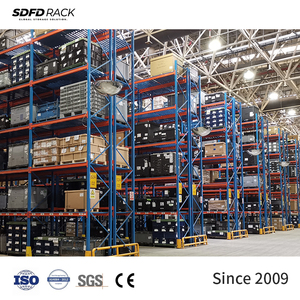
Heavy Duty Customized Steel Selective Pallet Rack System
A multi-level steel selective pallet racking system for high SKU variety, direct access and mixed pallet loads in industrial warehouses.
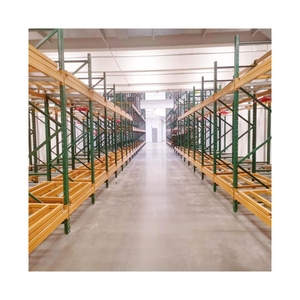
Custom Push Back Pallet Racking with Guide Rail
LIFO push-back racking with guide rail for dense pallet storage. A strong fit for fast-moving SKUs, cold stores and wholesale distribution.
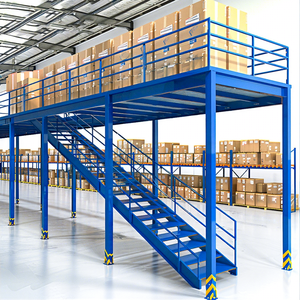
EU Warehouse Second Floor Wood Pallet Storage Platform
A second-floor storage platform for pallet and wood storage where floor space is constrained. Useful for retrofit capacity, picking and buffer storage.
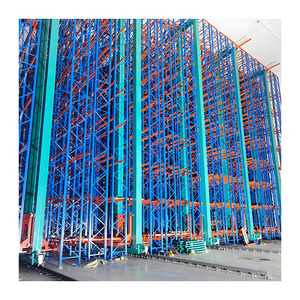
Automatic High-Density Heavy Duty Pallet Shuttle Racking System
High-density pallet shuttle racking with automatic controls and 3,000 kg load capacity. Recommended for high-volume, low-SKU warehouses.
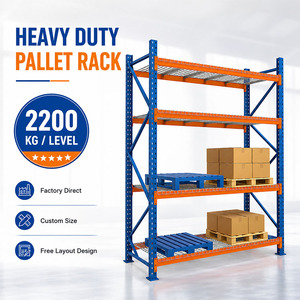
Heavy Duty Selective Pallet Racking Warehouse Storage System
Heavy-duty selective pallet racking for industrial storage and logistics. A practical baseline for distribution centres that need direct access to every pallet.
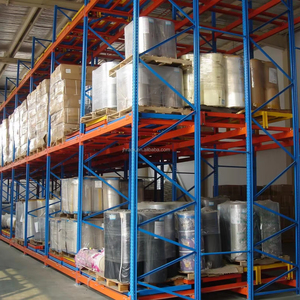
Heavy Duty Steel Industrial Pallet Rack Warehouse Storage System
Steel structures and heavy-duty industrial shelves for push pallet rack and warehouse shelving. Suitable for mixed warehouse projects and phased expansion.
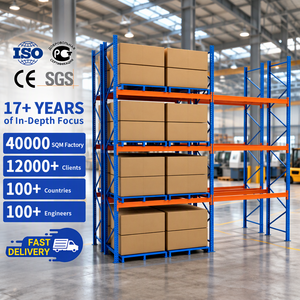
Heavy Duty Industrial Selective Pallet Racking System
High-loading, multi-level metal shelving units and selective pallet racking. Designed for warehouses that need stability, capacity and room to grow.
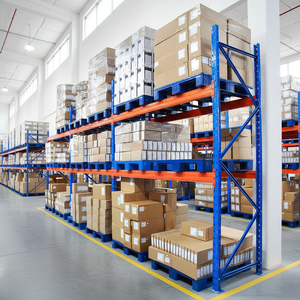
Heavy Duty Adjustable Pallet Racking for Logistics & E-commerce
Corrosion-resistant adjustable racking for logistics and e-commerce warehouses. Recommended where pallet profiles and SKU velocity change frequently.
Not sure whether selective, push-back, shuttle or mezzanine storage is the better commercial choice? Share your pallet data and our team can compare options.
Send an InquiryPush Racks, Selective Racking or Pallet Shuttle: A Buyer's Comparison
Push racks are not a single product category. In high-density warehousing, the term usually refers to push-back pallet racking — a LIFO system in which pallets are loaded onto wheeled carts or rails and pushed deeper into a bay. The commercial case is simple: fewer aisles, more pallet positions and a stronger return on warehouse space when the SKU count is controlled. However, push-back racking is not the best answer for every inventory profile. A wholesale distributor with thousands of fast-changing SKUs may need selective racking; a cold-store operator may favour mobile racking; a high-volume producer may justify a pallet shuttle.
The recommendation should be based on four data points: pallet size and weight, load per pallet, number of SKUs, and required selectivity. In South American warehouses, seismic zone, floor tolerance, clear height, forklift type and freezer temperature are equally important. A layout that looks efficient on paper can fail at handover if base plates, anchors, beam connectors and aisle widths are not coordinated with the site.
Use the comparison opposite as an early-stage guide. Final layouts should be verified by structural calculations and reviewed against EN 15512, FEM 10.2.08 / EN 16681, ABNT NBR 15524 or the relevant local code.
- Selective racking for direct access to every pallet.
- Push-back racking for LIFO density and fewer aisles.
- Pallet shuttle for high-volume, low-SKU storage.
- Second-floor platforms where footprint is fixed.
Illustrative Storage Profile Comparison
Illustrative only: density and selectivity depend on load profile, aisle width, handling equipment, temperature and local structural requirements.
Push-back racking
Best when SKUs are stable and LIFO is acceptable. Nested cart rails can reduce aisle count and increase pallet positions in existing buildings.
Selective pallet racking
Best when every pallet must be reachable and the SKU count is high. It is often the lowest-complexity baseline for distribution centres.
Pallet shuttle
Best for high-volume, low-SKU storage where truck movements, travel time and cube utilisation are key cost drivers.
Mezzanine and second floor
Best for footprint-constrained warehouses that can use vertical space for storage, picking, packing or offices without new construction.
What Warehouse Buyers Will Prioritise in the Next Procurement Cycle
Purchase decisions for push racks and warehouse storage are becoming more technical, more risk-aware and more lifecycle-focused. Price per bay still matters, but it is no longer the only comparison point.
Seismic and local-code evidence
Buyers in Chile, Peru, Colombia and Ecuador increasingly expect base plates, anchors, bracing and calculations to be evidenced against FEM 10.2.08 / EN 16681 and local codes. Documentation is becoming a scored procurement criterion.
Cold-chain energy efficiency
Freezer and chilled warehouses are evaluating racking that reduces refrigerated air volume. Mobile racking and high-density layouts can improve energy performance while supporting fruit, seafood, meat and dairy exports.
Automation-ready modularity
Procurement teams want racking that can start manual and later connect to shuttle, AGV or semi-automated storage. Modular platforms, clear aisle interfaces and accurate load data reduce the cost of future upgrades.
Total cost and lifecycle transparency
Wholesale buyers are comparing freight, installation, inspection, repair, spare parts and capacity upgrades — not just the racking price. A documented lifecycle plan is a stronger commercial offer than a low headline quote.
How Push Rack Systems Are Evolving
Racking development is moving toward greater density, better freeze-room performance and more useful documentation for facility teams. The most valuable innovations are often practical rather than cosmetic.
Hybrid high-density systems
Push-back cart rails are being combined with shuttle-style controls and smarter slotting. The aim is to preserve LIFO density while improving pallet tracking, operator safety and throughput.
Freezer-grade materials and finishes
Cold stores need steel, connectors and coatings that perform at low temperatures. Corrosion protection is also important in coastal ports and humid tropical climates.
Digital load signage and traceability
QR-coded capacity tables, inspection records and damage tracking help warehouse teams maintain safe operations and give auditors a clear evidence trail.
Retrofit-first engineering
More projects begin with an existing building. Designers now check floor tolerances, sprinkler clearance, column grids and phased installation before recommending a new racking layout.
Why Buyers Work With Real Nice Racks LLC
Real Nice Racks LLC designs, supplies and supports industrial storage systems — pallet racking, mobile racking, shelving, cantilever, mezzanines and semi-automated storage machines — for warehouses and distribution centres across South America. The advantage is not simply a product catalogue; it is the ability to connect engineering, export supply and lifecycle support.
Engineering-led layout and load review
Projects start with site survey, pallet data, clear height, forklift type and load profile. Load signage, capacity tables and structural documentation can be supplied with the installation.
Seismic and cold-chain specialisation
Racking for the Pacific seismic belt can be coordinated with NCh 433, NCh 2369, E.030, NEC-SE-DS and NSR-10 principles. Cold-store systems are specified for chilled and frozen environments down to approximately -30°C.
Manufacturing and wholesale supply
Export packing, port routing and project supply can be planned around Santos, Callao, San Antonio, Buenos Aires, Cartagena, Guayaquil and Montevideo. OEM, configuration and wholesale requirements are reviewed project by project.
Lifecycle support and local communication
Support is available in English, Spanish and Portuguese. After-sales services include rack inspection, damage repair, capacity upgrades and technical documentation for facility teams.
How We Move from Inquiry to Installed Push Racks
A clear project path reduces procurement risk and keeps engineering, freight and installation aligned.
Data capture
Warehouse location, floor plan, clear height, pallet dimensions, load per pallet, SKU profile, forklift type and temperature.
Layout and design
Compare selective, push-back, shuttle, mobile and mezzanine options. Confirm capacity, aisle widths and structural requirements.
Manufacture and export
Quality-controlled production, export packing, shipping to the nearest port and documentation preparation.
Install and support
Supervised installation, load signage, handover records, periodic inspection and future capacity upgrades.
Send Your Pallet Data, Get a Push Rack Layout and Wholesale Quotation
Share your warehouse location, pallet dimensions, load per pallet, clear height, SKU profile, forklift type, target capacity and temperature. For seismic or cold-store projects, include the site location and local code requirements so the layout review can start from the right design assumptions.
Send an InquiryTechnical and procurement enquiries: [email protected]
Common Questions from Push Rack Buyers and Wholesalers
These are the practical questions that usually shape a push rack, pallet racking or warehouse storage procurement decision.
What are push racks, and are they the same as push-back pallet racking?
In warehouse storage, “push racks” often refers to push-back pallet racking: pallets are placed on nested carts and pushed back along rails to create a high-density LIFO channel. The term can also be used broadly for high-density push pallet racking. For a precise quotation, confirm whether you need push-back, drive-in, pallet shuttle, selective or mobile racking, because each system has different selectivity, cart and forklift requirements.
How do I choose between selective racking and push-back racking?
Choose selective racking when every pallet must be accessible and the warehouse carries a high SKU count. Choose push-back racking when the SKU count is controlled, LIFO is acceptable and the main objective is more pallet positions per square metre. If throughput is high and the SKU count is very low, a pallet shuttle system may be the better high-density option. The final choice should be based on SKU velocity, pallet weight, truck type and required selectivity.
What load capacity and pallet dimensions should I provide for a quotation?
Please provide pallet length, width and height, load per pallet, load distribution, racking height, building clear height, floor slab condition, forklift or AGV type, operating temperature and required number of pallet positions. For heavy-duty or non-standard pallets, include drawings or photos. These details allow the engineering team to check beam capacity, upright loading, base plates, anchors and aisle clearances.
Can you supply racking for seismic zones in Chile, Peru, Colombia and Ecuador?
Yes. Racking for the Pacific seismic belt can be calculated with reference to FEM 10.2.08 and EN 16681, and coordinated with local requirements such as NCh 433 and NCh 2369 in Chile, E.030 in Peru, NEC-SE-DS in Ecuador and NSR-10 in Colombia. Base plates, anchors, bracing and beam connectors can be specified for the site's seismic zone and soil type, with final calculations reviewed by a locally licensed structural engineer where required.
Do you provide cold storage and freezer racking?
Yes. Cold storage pallet racking, mobile racking and high-density systems can be specified for chilled and frozen environments down to approximately -30°C. This suits fruit, seafood, meat and dairy export hubs across Chile, Peru, Ecuador, Argentina and Brazil. Mobile racking is especially useful in cold stores because it reduces the volume of air that must be refrigerated.
What are typical wholesale ordering, OEM and lead-time considerations?
Minimum order quantities, OEM requirements and lead times are reviewed project by project because they depend on racking configuration, finish, shipping method, destination port and documentation requirements. Buyers should share the target pallet count, installation schedule and any container-load consolidation requirements early. Lead times are confirmed after layout approval and order confirmation, with export packing and port routing planned accordingly.
Which standards and documents are supplied?
Static steel racking is designed in line with EN 15512, with floor tolerances per EN 15620, operation and inspection guidance per EN 15635, and seismic design per FEM 10.2.08 / EN 16681. In Brazil, projects can be aligned with ABNT NBR 15524 for selective pallet racking. Load signage, capacity tables and inspection records can be supplied with the installation.
Can you upgrade an existing warehouse instead of building new?
Yes. Retrofit projects often combine re-layouts, higher-density systems such as push-back, drive-in, shuttle or mobile racking, mezzanine floors and narrow-aisle configurations. High-density pallet racking can deliver up to 20% more storage capacity within the same building footprint, helping buyers avoid the cost and delay of new construction. The first step is a floor plan, clear height and pallet data review.
Ready to Compare Push Rack Options?
Send your warehouse data for a technical review, product recommendation and wholesale quotation. Helpful details include location, floor plan, clear height, pallet size and weight, SKU profile, handling equipment, temperature and target pallet count.