A well-chosen Pallet Storage Racking System does more than hold pallets. It shapes how quickly staff can reach stock, how much floor space remains open, and how safely loads move through a warehouse. The choice is practical: a distributor with fast-moving cartons may need different access than a facility storing seasonal goods in deep lanes. Small details matter, including pallet dimensions, forklift turning space, beam levels, and the weight of each load.
Industry data points to why these decisions deserve care. MHI’s 2024 Annual Industry Report found that 55% of surveyed supply-chain leaders planned to increase investment in technology over the next five years. That figure is not a rack-sales statistic, but it reflects pressure to make storage and material handling more efficient. Rack Manufacturers Institute (RMI) guidance also emphasizes that rack capacity depends on the specific frame, beam, configuration, and installed conditions—not simply a product label.
For an individual expert quotation, a verifiable published source is needed; no quotation is supplied here rather than inventing one. With that evidence-based starting point, this guide compares selective, drive-in, push-back, pallet-flow, and other common rack types. Each has trade-offs. More storage density can mean less direct access, and a layout that looks efficient on paper may frustrate operators in a busy aisle.
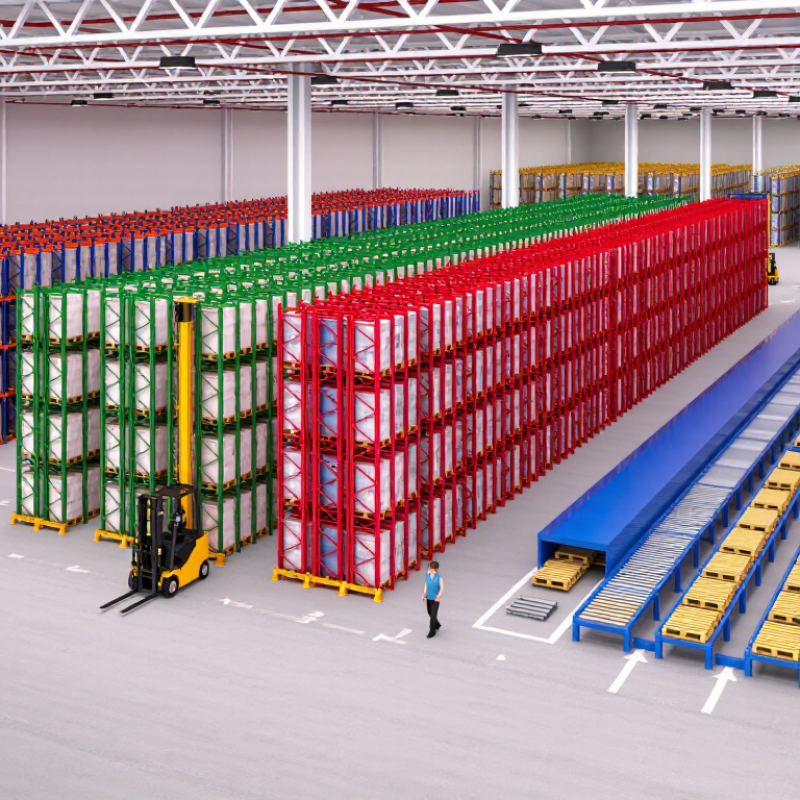
Selective Pallet Racking for Direct Access to Every Load
Selective pallet racking gives operators direct access to every pallet position. Each load sits in its own location, rather than behind another pallet. This arrangement suits warehouses with many product types and frequent order changes. A picker can reach a specific carton or pallet without moving neighboring stock. That saves handling time and reduces unnecessary reshuffling.
The layout is straightforward. Upright frames support horizontal beams, while each beam level holds palletized goods. Forklift aisle width matters: wider aisles can improve maneuverability, but they also use valuable floor space. Check pallet dimensions, loaded weights, and forklift turning needs before setting beam heights. Clear load signs help staff avoid placing heavy pallets above the rack’s rated capacity. Small details count.
Direct access does not mean every layout is automatically efficient. Too many aisles may reduce storage density, while narrow aisles can slow picking or create clearance problems. A practical design balances access, inventory variety, and available floor area. Inspect frames and beams regularly for impact damage, especially near busy aisle ends. Even a small bend deserves attention; it is easy to overlook during a rushed shift.
Drive-In and Drive-Through Racking for High-Density Storage
Drive-in and drive-through racking place pallets several positions deep, reducing the number of aisles needed. Forklifts enter the storage lanes and place pallets on side rails. Drive-in systems usually work on a last-in, first-out basis, making them suitable for large batches of a few SKUs. Drive-through systems allow loading from one end and picking from the other, supporting first-in, first-out rotation. The trade-off is real: deeper lanes save floor space but reduce direct access to individual pallets.
MHI’s 2024 Annual Industry Report found that 55% of surveyed supply-chain professionals planned to increase investment in supply-chain innovation. That trend makes it worth checking whether dense storage will work with the operation’s tracking and handling processes, not just its floor plan. A lane holding twelve pallets of one SKU may be efficient; a lane holding mixed products can become a retrieval puzzle. Very quickly.
Before installation, measure pallet loads, forklift clearance, ceiling height, and lane depth. Check how replenishment and picking will affect each other during busy shifts. Rack design and protection also require careful review by qualified professionals; small layout assumptions can create large operational problems. A useful design question is not simply how many pallets fit, but how reliably workers can reach the right pallet at the right time.
Push-Back Racking for Lane-Based Inventory
Push-Back Racking for Lane-Based Inventory
Push-back racking suits warehouses that store several pallets of the same product in each lane. Forklifts load pallets from the aisle onto nested carts. Each new pallet pushes the previous one deeper. During picking, the next pallet rolls forward under gravity. The result is more storage positions per aisle than selective racking, though access is less direct. Think of a lane holding several blue-pallet loads of one fast-moving item. It works best when stock rotates by batch and each lane has a clear product assignment.
WERC’s 2023 DC Measures report treats order-picking accuracy as a core warehouse benchmark, with a median of about 99.5%. That figure is a useful reminder: dense storage still depends on accurate location control. Push-back lanes typically operate on last-in, first-out logic, so they are a poor match for products requiring strict first-in, first-out rotation. Lane depth, pallet condition, and load consistency also matter. A damaged pallet can snag a cart. Awkward loads may shift. Not every SKU belongs here. Before installation, test representative pallets and confirm the rack design, floor condition, and operating procedures with qualified professionals. Teams should also check lane labels and actual inventory regularly; that step is easy to underestimate.
Top Lane-Based Pallet Storage Racking Systems
Push-back and drive-in lanes are accessed from one end and typically operate on a last-in, first-out basis. Drive-through and pallet-flow lanes have loading and unloading ends, supporting first-in, first-out rotation.
Pallet Flow Racking for FIFO Stock Rotation
What Are the Top Types of Pallet Storage Racking Systems?
Pallet Flow Racking for FIFO Stock Rotation
Pallet flow racking uses inclined roller lanes to move pallets from the loading side toward the picking face. Gravity advances each load as workers remove the pallet at the front. This supports first-in, first-out stock rotation, useful for dated goods and products with limited shelf life. The lane should move steadily, not like a runaway cart.
The 2024 MHI Annual Industry Report, produced with Deloitte, found that 55% of surveyed supply-chain professionals planned to increase technology investment. That figure reflects wider interest in operational improvements, but it does not prove that flow racks suit every warehouse. Their performance depends on pallet quality, load weight, lane depth, and correct installation. A damaged pallet can snag on rollers and disrupt the whole lane.
Before specifying a system, measure the actual pallets and test representative loads. Check that the incline moves heavy pallets reliably without making lighter ones accelerate too quickly. Keep replenishment and picking traffic separate where possible, and inspect rollers, brakes, and guides on a regular schedule. There is a trade-off: flow lanes can improve rotation and reduce travel, but they are less flexible than selective racks when product mixes change. Reconfiguration can be awkward.
Pallet Shuttle and Automated Racking Systems
Pallet shuttle systems use a powered carrier to move pallets through deep storage lanes. A forklift places the shuttle and load at the lane entrance, then the carrier travels along rails. This reduces forklift movement inside the rack and can make better use of floor space. Short travel paths matter. In a busy warehouse, fewer repeated turns can also ease congestion near picking areas. Lane design determines whether operations follow a last-in, first-out or first-in, first-out flow.
Automated racking connects storage lanes with equipment such as conveyors, lifts, and control software. Together, these components move pallets between receiving, storage, and dispatch points with limited manual handling. The result can be faster, more consistent movement, especially where pallet volumes are high and product dimensions are predictable. But automation is not magic. A blocked conveyor or poorly coordinated handoff can slow the whole process, so maintenance access and backup procedures deserve attention during planning.
The right choice depends on daily throughput, pallet variety, building height, and how often stock must be retrieved. Shuttle systems can suit dense storage with many pallets per product; broader automation may fit operations needing frequent, coordinated transfers. Measure real order patterns, not just peak-season estimates. Small discrepancies matter. I would also test how operators handle damaged pallets and lane changes before committing: these details are easy to overlook on a clean layout drawing.
Conclusion
A Pallet Storage Racking System can be selected to balance accessibility, storage density, inventory flow, and operational needs. Selective pallet racking provides direct access to every load, making it suitable for facilities that handle many products and need frequent picking. Drive-in and drive-through systems store pallets in deep lanes to use space efficiently, while push-back racking supports lane-based storage with pallets moving forward as loads are added or removed.
For stock rotation, pallet flow racking uses gravity to move pallets through lanes, helping support first-in, first-out handling. Pallet shuttle and automated racking systems use powered equipment or automation to move and manage loads, which can reduce manual travel in high-volume operations. Each option offers different trade-offs in access, capacity, and inventory control, so the right choice depends on the facility’s products, handling processes, and storage priorities.