A warehouse can look spacious at the loading door and feel crowded by mid-shift. Pallets sit in travel lanes, pickers take longer routes, and overflow stock hides behind fast-moving items. Pallet Racking offers a practical way to use vertical space and make stored goods easier to locate. The right layout can also support clearer replenishment and picking routines. But racks are not magic. Poorly planned aisles or unsuitable beam levels can create new bottlenecks.
The cost of logistics makes storage decisions worth examining. The Council of Supply Chain Management Professionals’ 2024 State of Logistics Report estimated U.S. business logistics costs at $2.374 trillion in 2023, or 8.7% of GDP. MHI’s 2024 Annual Industry Report also found that 55% of surveyed supply-chain professionals planned to increase technology investment. These figures do not prove that racking alone reduces costs. They do show why operators are reviewing how space, equipment, and processes work together. Start with the inventory: pallet dimensions, load weights, turnover rates, and handling equipment all matter. Then compare selective, drive-in, or other rack configurations against actual workflows, not just a floor plan. Leave room for inspection and safe movement. A detailed assessment may feel slow. It is still better than discovering, after installation, that the busiest pick face sits too far away.
What Is Pallet Racking and How Does It Work?
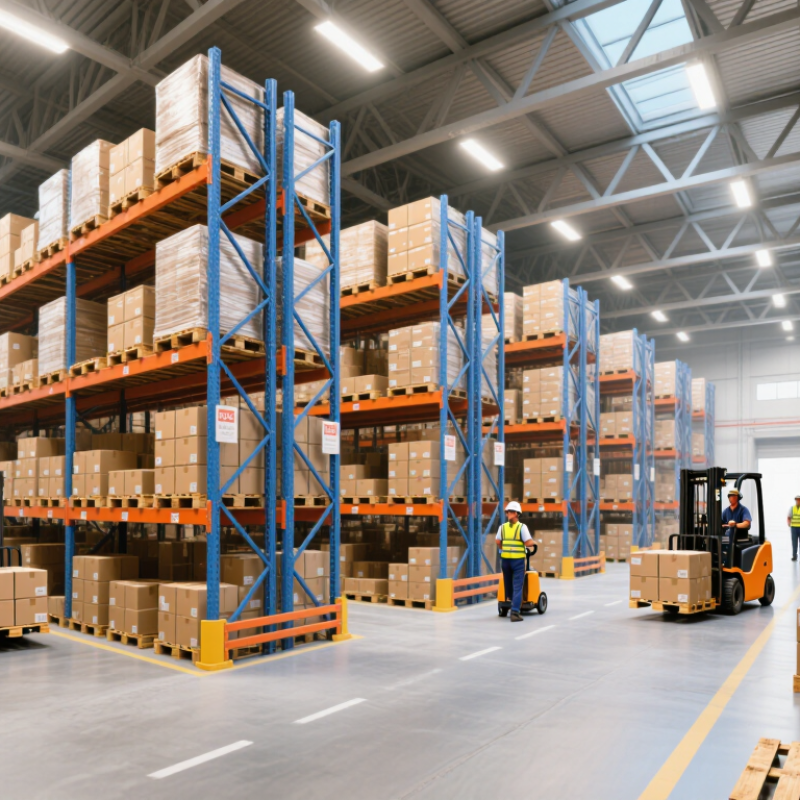
Pallet racking is a steel framework that stores palletized goods in vertical levels. Upright frames support horizontal beams, creating bays where forklifts place and retrieve loads. In selective racking, each pallet has direct aisle access, which makes picking straightforward. A forklift lifts a pallet onto a beam pair; the beam locks into the frame, and the load rests on the beams. Simple, but not forgiving: capacity depends on the rack configuration, pallet weight, and how loads are distributed. The 2024 MHI Annual Industry Report found that 55% of surveyed supply chain professionals planned to increase investment in technology and innovation. That reflects growing pressure to coordinate warehouse equipment and operations, though it does not prove that any one rack design suits every facility.
Rack choice affects more than storage density. Aisle width must suit the forklift, while beam height needs to clear the pallet and the load above it. Workers should check that pallets sit evenly and that rack components show no visible damage. A small mismatch can cause trouble. Layouts also need regular review as inventory and equipment change; this is easy to overlook.
Tips: Measure pallets, loads, forklifts, and aisles before setting beam positions. Keep heavier loads on lower levels, follow the rack supplier’s stated capacity, and record inspections. If a beam is bent or a connector is damaged, take the affected bay out of service until a qualified person checks it.
FAQS
It gives forklifts direct access to every pallet position. This suits warehouses with many product lines and frequent picking. A carton can be reached without moving another pallet.
Drive-in racking stores similar goods several pallets deep. Forklifts enter the storage lanes, so access follows a last-in, first-out pattern. It may fit large batches, but not every product mix.
Each newly loaded pallet pushes the previous one backward along rails. This can make loading and retrieval quicker than entering a lane. Selectivity is reduced. A practical trade-off.
Rollers move pallets from the loading side toward the picking side. This supports first-in, first-out stock rotation. Pallets need consistent dimensions and sound boards; damaged boards can jam the rollers.
Its open arms can hold long items such as timber or pipe. The open front avoids the usual front columns. Not every warehouse needs it.
It uses vertical space with defined beam levels instead of floor-stacking every pallet. Rack height should suit pallet sizes, ceiling clearance, and the handling equipment.
No. Clear labels and consistent stock locations help staff find similar cartons. Accurate inventory records still matter, especially during busy shifts.
Compare pallet weight, product turnover, forklift type, aisle clearance, and available headroom. Qualified professionals should verify load ratings and floor conditions. I would question any plan that leaves almost no room for changing stock.
Conclusion
Pallet Racking is a structured storage system that keeps palletized goods organized and accessible. Upright frames and horizontal beams create storage levels, while forklifts or other handling equipment move pallets into and out of position. Different systems suit different needs: selective racks provide direct access to each pallet, while drive-in, push-back, and pallet-flow designs can increase storage density or support specific inventory rotation patterns.
By making better use of vertical space and organizing stock into clear locations, pallet racking can improve capacity, picking efficiency, and inventory visibility. It is useful in distribution centers, manufacturing facilities, retail warehouses, and other operations that store palletized goods. Choosing the right system means considering available floor space and ceiling height, pallet dimensions and loads, product turnover, access requirements, and handling equipment. A well-matched design can support safer, more efficient storage as a warehouse’s needs change.
